

Lot n° 240
Estimation :
4000 - 6000
EUR
Result with fees
Result
: 26 670EUR
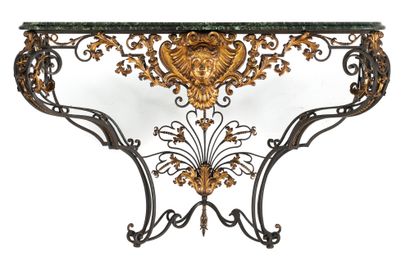
Console - Lot 240
Console
in wrought iron and gilded sheet metal, decorated with acanthus leaves and scrolls. The centerpiece is a medallion in a cartouche. Curved legs joined by a brace topped by an openwork palmette.
18th century regional work
Green marble top
(some wear to the gilding)
H : 92 W : 137.5 D : 59 cm
A console table in the Frick Collection, New York, is close to our example and could form a counterpart in the great tradition of Louis XV metal consoles for vestibules (inv. no. 1914.5.32). Before being bequeathed by Henry Clay Frick to the New York institution of the same name, this second console was part of the collection of the American actress and decorator Elsie de Wolfe(1).
Bibliography:
(2) Arnaud d'Agnel, Le Meuble : Ameublement Provençal
& Comtadin du Moyen-Âge à la fin du XVIIIème siècle,
Tacussel, 1929.
(1) Theodore Dell, David DuBon, Joseph Focarino,
The Frick collection: an illustrated. V . Furniture .
Italian and French. Ed. the Frick collection, 1992,
pp. 258-262.
(3) Ibid. see note 2
- Alain Renner, Mobilier de métal de l'Ancien Régime
à la Restauration, Monelle Hayot, 2009.
Eighteenth-century wrought-iron consoles make up an extremely small group. Created by the same master wrought-iron craftsmen and locksmiths who adorned railings, balustrades and gates, these works testify to the high level of technical mastery achieved by French ironwork during the reign of Louis XV(2).
Made entirely from iron, the material is red-hot, then hammered and hot-formed in sturdy wooden molds. The plates are embossed onto finely sculpted dies, carefully chiselled and then gilded with gold leaf. The assembly of the various parts relies exclusively on riveting, keying and eyelet techniques, without recourse to joinery.
Although they were produced in different regions, Provence and the Comtat Venaissin were the most active centers. Towns such as Aix, Arles, Avignon, Carpentras and Marseille perpetuated a tradition of wrought ironwork inherited from the Middle Ages. Abbé d'Agnel, in his work on the decorative arts of the region, mentions several similar consoles, often cited in 18th-century inventories among the furniture of vestibules, salons or dining rooms.(3) The names of locksmiths active at the time are known, but it remains difficult to attribute these consoles to a precise craftsman. However, an inventory from 1766 mentions a wrought-iron table belonging to the metalworker Esprit Eyriès, probably made by him. While the Musée Calvet in Avignon preserves a small documented console by locksmith Alexis
Benoît, a contemporary of Eyriès.
My orders
Sale information
Sales conditions
Return to catalogue