

Lot n° 107
Estimation :
4000 - 6000
EUR
Result with fees
Result
: 38 100EUR
Vincennes - Lot 107
Vincennes
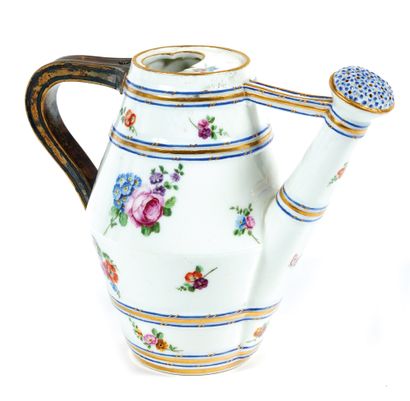
Watering can (apartment watering can) with polychrome decoration of bouquets of flowers, blue fillets and gold clasps on the edges.
Round spout with multiple interlocking blue flowers. Missing handle replaced by a vermeil handle or pompom?
Marked in blue with interlaced LL, year 1755
18th century
H. 20 cm
Cf: This watering-can shape was created in two sizes in 1754. The mold appears in the stock book in both sizes. The structure is formed by two milk cups placed face to face, creating a large central part, with a handle on each side and a spout formed by a bouquet of forget-me-nots. It could contain a perfumed essence to reactivate potpourri or scent porcelain flowers. (R.Savill, 2021-117)
Marcelle Brunet and Tamara Préaud report that the first cookie watering can is mentioned in the batch on July 10, 1954, then in November 1754 four watering cans are listed (2 in first size and 2 in second size), then six more in second size in 1755. The enameling batch lists just one in first size in November 1754, three in second size in 1755 and four in first size in 1756.
A second-size enameled watering can is valued at 18 livres in 1755.
In the inventory of Madame de Pompadour's purchases from the marchand-mercier Lazare Duvaux, on December 24, 1755, she is supplied with a second-size watering can. (LD 2336)
In 1758, the sale store sells two second-size watering cans valued at 108 livres each and three first-size watering cans valued at 120 livres.
All watering cans are decorated with polychrome or blue monochrome flower sprays with gold fillets. Finally, thirteen watering cans are listed in the sales book between November 1755 and June 1757
including three in first size and ten in second size.
Today, we know of only seven, three of the first size in the Cité de la Céramique (Inv MNC 21593) and in a private collection, and four of the second size in the Getty Museum, Los Angeles, USA (inv 84.DE.89.); the Gardner Museum, Toronto, Canada (inv G84.1.3), the Nelson-Atkins Museum of art, Kansas City (inv F94-20), the C.L. David Collection, Copenhagen and an English private collection. Watering cans were sold in the 19th century, without any size description, including two from the collection of the Earl of Lonsdale in 1887, one with a metal handle decorated with polychrome flowers. In 1920, a watering can with polychrome flowers and a metal handle appeared in the sale of the Comtesse de Béarn. It is highly probable that the one presented today came from the Lonsdale then Bearn sale. Vincennes and Sèvres Porcelain, the Paul Getty Museum, Adrian Sassoon.
A SMALL WATERING CAN FILLED WITH PERFUME
Between 1754 and 1756, the Vincennes factory produced a small number of watering cans in soft porcelain, of which only nine are recorded in the production records. These delicate objects, decorated with polychrome flower bouquets, were aimed at a refined clientele close to the court. The registers indicate a price of 120 livres for the first-size model and 108 livres for the second-size model.
Fans of these little watering cans included Madame de Pompadour, patron of the Vincennes factory, whose enemies took pleasure in spreading malicious rumors. One of them told how, during the winter, to amuse the king, she spent a fortune on porcelain flowers "planted" in the garden of her Bellevue château, which she watered with a small porcelain watering can filled with perfume.
This fashion for miniature watering cans continued into the 19th century. In 1816, when Marie-Louise, Duchesse de Berry, moved into the Élysée Palace, a witness wrote:
La Marquise de Pompadour en belle jardinière after Carle Van Loo
"When the princess arrived, the room was hung with blue fabric; in the windows were placed two jardinières of natural flowers, which the young woman takes care of with a silver spade, and a watering can of Sèvres porcelain."
My orders
Sale information
Sales conditions
Return to catalogue