

Lot n° 168
Estimation :
8000 - 12000
EUR
Register for the sale on drouot.com
Leave absentee bid
Your amount
EUR
Bid by phone
Bid by phone
Your amount
EUR
CHINA - Kangxi Period (1662–1722) - Lot 168
CHINA - Kangxi Period (1662–1722)
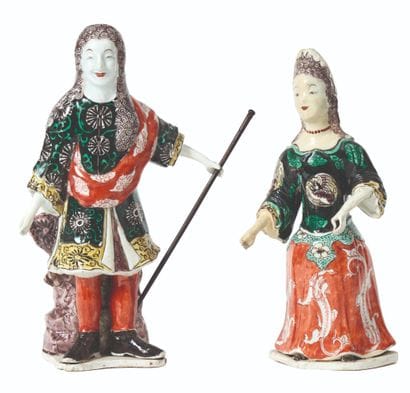
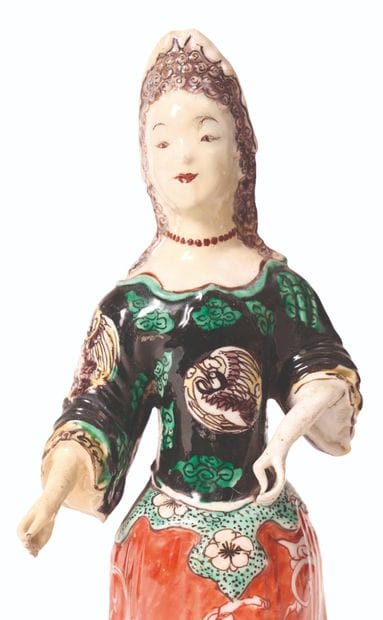
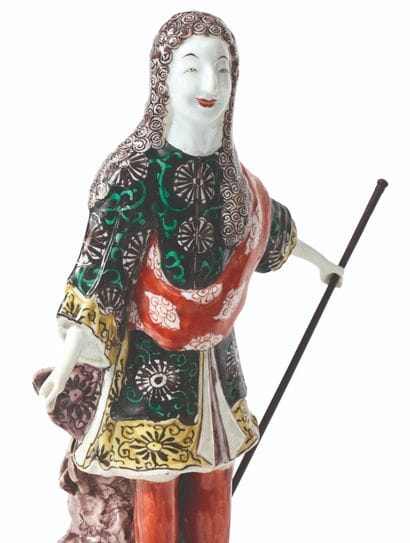
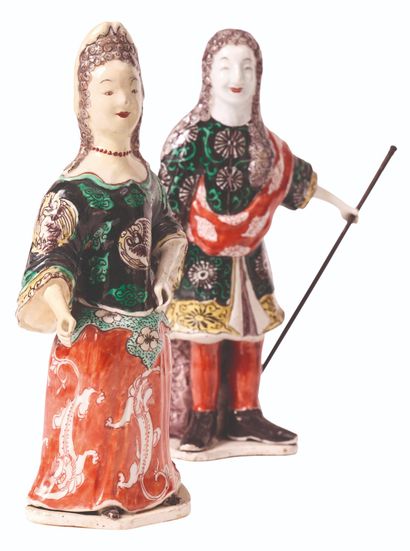
A pair of French figures in polychrome glazed porcelain. The man is wearing a black jacket decorated with stylized flowers and a red scarf adorned with clouds. He is leaning against a rock, his left arm outstretched. Originally, he would have been holding a tricorn hat in his right hand. The woman is wearing a red skirt adorned with a dragon and a black jacket decorated with phoenix medallions. She wears a Fontanges-style hairstyle.
Man: Height 25 cm
Woman: Height 23.5 cm
(Restorations, missing parts)
References:
- Three similar pieces held at the Peabody Essex Museum, Salem, and illustrated in William Sargent, *The Copeland Collection: Chinese and Japanese Ceramic Figures*, Salem, 1991, pp. 104–105
- A pair at the Victoria and Albert Museum, London, from the Basil Ionides Bequest (nos. C.109-1963 and C.109A-1963)
- A pair in Dresden in the collection of Augustus the Strong, reproduced in *La Maladie de Porcelaine…*: East Asian Porcelain from the Collection of Augustus the Strong, Leipzig, 2001, pl. 22
- A pair reproduced in Howard and Ayers, *China for the West*, Sotheby’s Parke Bernet, 1978, no. 601, p. 580
- Other statuettes are housed at the Guimet Museum and the Cernuschi Museum.
The models for these Western figures likely derive from engravings by Nicolas and Robert Bonnart (1637–1718 and 1652–1733), members of a prominent Parisian dynasty of publishers and engravers based on Rue Saint-Jacques, famous for its depictions of court figures and its fashion engravings.
The gentleman is traditionally identified as the Grand Dauphin, son of Louis XIV, while the female figure has been linked to Madame de Maintenon or Madame de Montespan. Their costumes are inspired by the fashion of the French court around 1700. Several variations of these models are known, differing notably in their gestures and clothing.
Produced in Jingdezhen in the early 18th century, these rare figures are among the earliest depictions of Westerners made in Chinese porcelain. They bear particularly eloquent witness to the artistic exchanges between China and Europe: the European model is freely reinterpreted here by Chinese painters. Notably, the woman’s jacket features medallions in the shape of flying cranes, and her skirt is adorned with dragons.
My orders
Sale information
Sales conditions
Return to catalogue